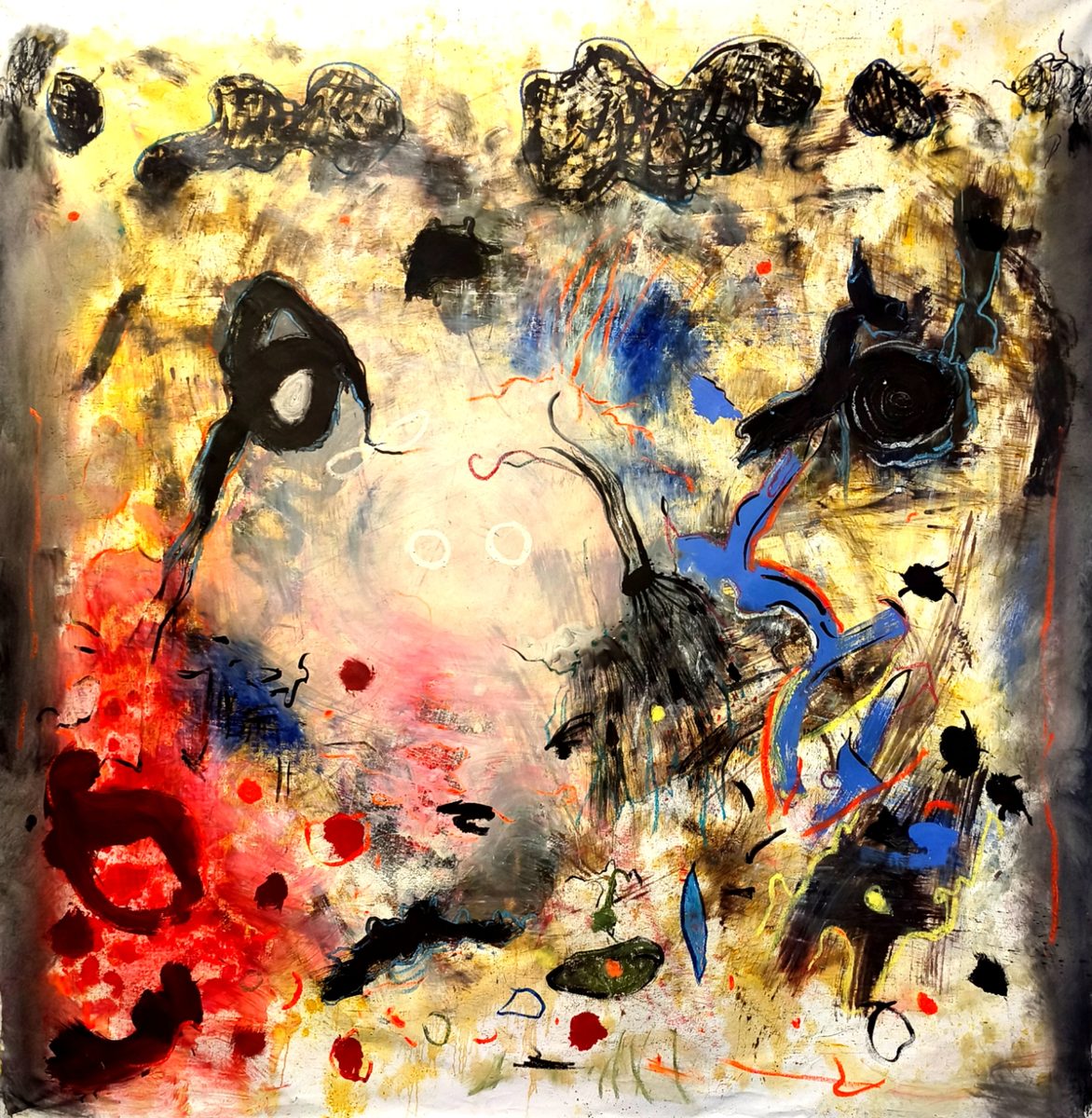
Curatorial Analysis — Refuge (200 × 200 cm, natural pigments, linseed oil, oil bars)
Refuge is the largest and, I would argue, the most complete work in Karel Stoop's recent series. At 200 × 200 cm — a perfect square — it imposes itself on the space with a different authority than the horizontal canvases that precede it. There is no panoramic sweep here, no implied movement from left to right. The eye is held, enclosed, asked to descend.
The golden ground — raw umber and yellow ochre layered with natural pigments — radiates a warmth that is immediately at odds with the turbulence of the surface. Black forms surge upward from the lower register: a great looping figure on the left, a spiral eye on the right that recalls the cosmic motifs of the earlier works, now darker, more insistent. In the lower left, a red explosion erupts — visceral, almost violent — while the centre opens into a pale, luminous field of pink and grey, strangely quiet amid the surrounding storm.
This is the refuge of the title: not a safe house or a shelter from reality, but a space within the painting itself — a clearing in the midst of density, a breath held between gestures. Stoop respects the invisible structures that guide our perception, yet deliberately attempts to move beyond them. In doing so, the painting does not simply present a visual balance but opens the possibility of a wider, mental landscape.
The layers of colour and texture are not just material but also symbolic, pointing to the tension between boundaries and freedom. Created with natural pigments, linseed oil and oil bars, the surface carries a particular materiality — grainy, textured, alive to the touch of light. It is a painting made of the earth it depicts.
The title Refuge suggests a place of retreat, and the painting embodies exactly that: a space where the mind can take shelter from limitations, external pressures, and the endless obligations of daily life. Yet this retreat is not passive — it is charged, alive, full of the energy of its own making.
Refuge does not resolve; it sustains. It is among the most spatially commanding and emotionally resonant works in Stoop's recent practice — a fitting culmination of a body of work that has consistently pushed toward the edges of what painting can hold.